Lightning is one of the main weather hazards that can bring airport ground operations to a sudden halt, putting outdoor crews at risk while triggering costly delays across the aviation network.
For airports, airlines, and Fixed Base Operators (FBOs), OSHA’s General Duty Clause establishes a clear responsibility to protect workers from recognized lightning hazards. Even so, it does not prescribe a single operational standard for how that duty must be carried out. As a result, airport operators must translate a broad duty of care into defensible protocols, drawing on guidance from the FAA, IATA, and other aviation safety benchmarks. In practice, that means making deliberate choices about what hazards to monitor, what technologies to rely on, when to suspend and resume outdoor work, and how to communicate risk quickly and consistently across the airfield.
In this blog, we’ll explore the key elements of building a defensible lightning safety protocol for airport ground operations, including:
- The scale of lightning and weather risk.
- The concentration of lightning risk where aviation demand is high.
- Why lightning risk is a ground operations problem.
- What goes into monitoring lightning risk.
- When to suspend outdoor operations.
- Alerting stakeholders to lightning risk.
- Dealing with the dual dimensions of lightning risk.
- Centralizing oversight of lighting safety.
- Bringing it together for a defensible lightning safety protocol.
The scale of lightning and weather risk
Each year, the Federal Aviation Administration (FAA) oversees approximately 16.2 million flights across 19,482 airports. About 1 in 4 of those flights encounters some form of delay, costing the industry approximately $30 billion annually.
The top reason for those delays? It’s the weather.
Based on data from 2017-2023, the FAA reported that weather accounted for about 74%of all delays. More recently, the U.S. Department of Transportation looked at data for August 2024 through July 2025, reporting that about 29% of all arrival delays were due to weather. Either way, weather-related delays add up to a multi-billion-dollar problem for the aviation industry. What’s more, the top cause of all those weather delays is convective storms and the lightning that comes with them.
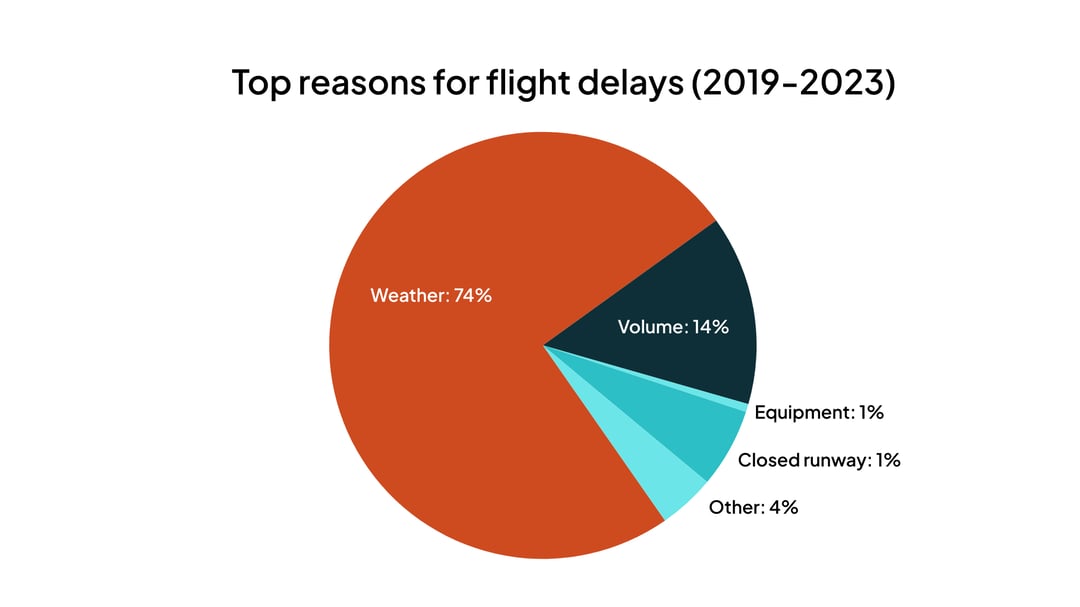
Either way, weather-related delays add up to a multi-billion-dollar problem for the aviation industry. What’s more, the top cause of all those weather delays is convective storms and the lightning that comes with them.
Lightning risk is concentrated where aviation demand is high
Of course, lightning exposure is not uniform; it varies across seasons and regions. Unfortunately, it also tends to concentrate in ways that increase its overall impact on aviation.
For example, it tends to peak during the summer months when airlines are hitting their peak travel season. And some of the most central hubs in the U.S. airport network experience some of the most lightning.
| Airport | Passengers Boarded | 2025 Total Lightning Flashes | Peak Lightning Day |
| Hartsfield-Jackson Atlanta International | 52,511,308 | 10,642 | June 27, 2025 |
| Dallas-Fort Worth International | 42,351,282 | 17,754 | August 4, 2025 |
| Denver International | 40,013,445 | 6,039 | August 10, 2025 |
| Chicago O'Hare International | 38,575,654 | 10,322 | August 17, 2025 |
| Los Angeles International | 37,762,558 | 15 | November 21, 2025 |
| John F Kennedy International | 31,209,177 | 2,424 | June 19, 2025 |
| Charlotte-Douglas International | 28,523,298 | 7,006 | August 1, 2025 |
| Orlando International | 27,859,642 | 31,937 | August 5, 2025 |
| Miami International | 26,591,472 | 28,189 | May 4, 2025 |
| Harry Reid International | 26,183,204 | 1,521 | June 3, 2025 |
AEM’s 2025 United States Lightning Report ranked the 10 busiest airports in the U.S. based on their 2025 lightning exposure. It showed that three of the nation’s busiest and most central airport hubs (Chicago O’Hare, Dallas-Fort Worth, and Atlanta) all ranked among the top five for lightning exposure. The only airports with greater exposure were Miami-Dade and Orlando International in Florida.
Lightning risk as a ground operations problem
Fortunately, modern airplanes and airport facilities are built to withstand lightning strikes with minimal damage while protecting the people and electronics inside them. But the people who must venture onto open tarmac—including marshals, baggage handlers, maintenance technicians, fuel truck drivers, catering staff, cabin cleaning crews, and other ramp agents—still face significant risk.
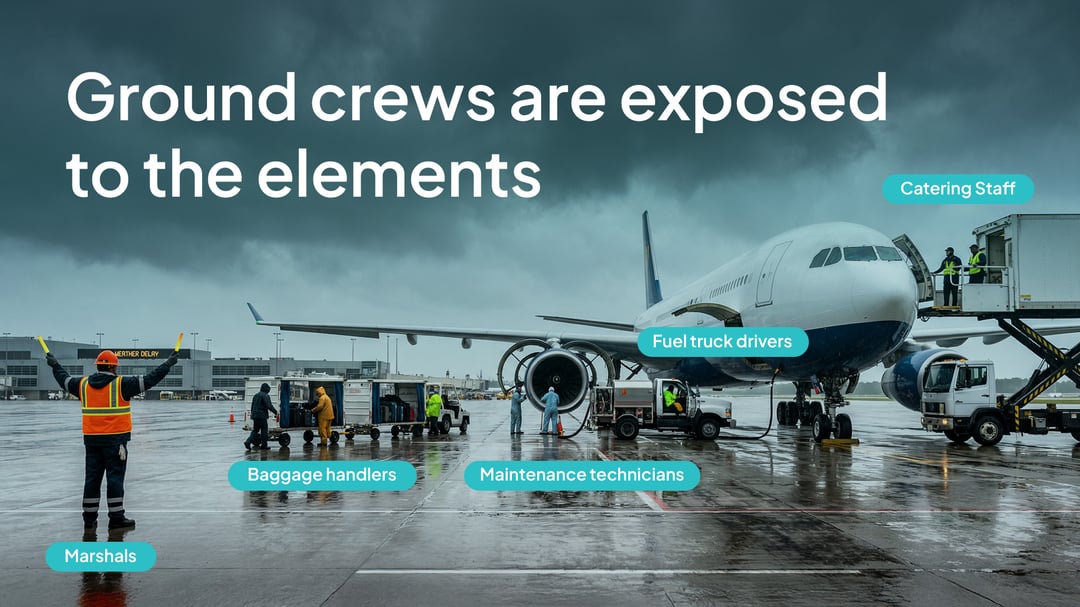
The only safe way to deal with lightning risk is to suspend outdoor ground operations and bring personnel indoors when lightning is in the vicinity. In fact, it’s the law. OSHA’s General Duty Clause (Section 5(a)(1)) requires employers to protect workers from recognized lightning hazards during outdoor operations. Employers must implement safety plans, monitor weather, and suspend work when thunderstorms are nearby, or face legal citations.
That might sound simple, but it’s not. Throughout the rest of this blog, we’ll explore the nuances involved in applying OSHA’s guidance.
Monitoring lightning hazards
The OSHA standard, along with recommendations from the FAA and IATA, requires that employers monitor lightning hazards. The problem is that the requirement is ambiguous on at least two fronts: (1) Exactly what needs to be monitored? (2) How does it need to be monitored?
WHAT TO MONITOR: TOTAL VS. CLOUD-TO-GROUND LIGHTNING
When it comes to ground operations, we obviously care about the lightning that strikes the ground. This is the lightning that inflicts direct harm.
The problem with looking only at cloud-to-ground lightning is that it may leave little or no time to react. If a storm develops overhead or nearby, the very first strike could be fatal.
Fortunately, in-cloud lightning is often a precursor to cloud-to-ground strikes. In-cloud lightning also accounts for the vast majority of the total lightning in a storm cell. That’s why proactive management of lightning risk requires a system based on observations of both cloud-to-ground and in-cloud lightning (i.e., total lightning).
HOW TO MONITOR: LIGHTNING DETECTION VS. LIGHTNING PREDICTION
Notice that we said the system should be based on observations of total lightning.
Some systems are built around lightning prediction instead of detection. Predictive systems claim to sense the probability of lightning via a sensor on the customer’s site. Unfortunately, predictive approaches have shown significant limitations.
We tested one such predictive system against observations from AEM’s Earth Networks Total Lightning Network® (ENTLN) over a seven-month period. On every metric, the predictive solution fell short.
- The predictive system missed 49% of the storms.
- It issued false alarms about 16% of the time.
- The predictive system gave an all-clear signal 14% of the time when lightning was still present in the area.
Those differences are critically important for airport ground operations. Every missed lightning flash or premature all-clear signal can put lives in jeopardy. And every false alarm can trigger costly air traffic delays.
HOW TO MONITOR: TECHNIQUES FOR COLLECTING OBSERVATIONS
Once a ground operator settles on using lightning observations to inform its safety procedures, the next question becomes: how should it collect the observations?
Some airport operations still make the call to stop operations based on visual observations (like storm clouds overhead or lightning in the distance). The problem is that these sorts of observations are both inefficient and dangerous. They are inefficient because lightning can sometimes be seen far beyond the distance at which it poses a significant threat. And they are dangerous because it may already be too late to get everyone to safety when a storm cloud is overhead.

An alternative is to rely on one or more on-site sensors that are designed specifically to detect lightning. On-site sensors will generally be safer and more efficient than visual detection alone. But they also have important limitations.
- First, on-site sensors are vulnerable to being struck by lightning, blown debris, etc. As a result, they could be incapacitated when they are most needed.
- Secondly, most safety procedures depend on knowing where lightning is occurring. However, lightning location is typically calculated through a process known as triangulation. A single sensor operating in isolation would be unable to identify the precise location of lightning.
This brings us to the third alternative: leverage a network of electronic lightning detectors. Sensor networks are less prone to going out of service. Even if one sensor goes out, there are others to take its place. And sensor networks are better equipped to triangulate the precise location of individual lightning flashes.
In many cases, the best solutions will opt for an on-site sensor (to optimize local coverage) that is integrated into a larger network solution (to ensure reliable detection and precise location).
When should you suspend outdoor operations?
The OSHA General Duty Clause requires that outdoor work be suspended when thunderstorms are nearby. But what counts as “nearby”? Unfortunately, the guidance on this issue has not always been clear.
HOW FAR DOES LIGHTNING RISK EXTEND?
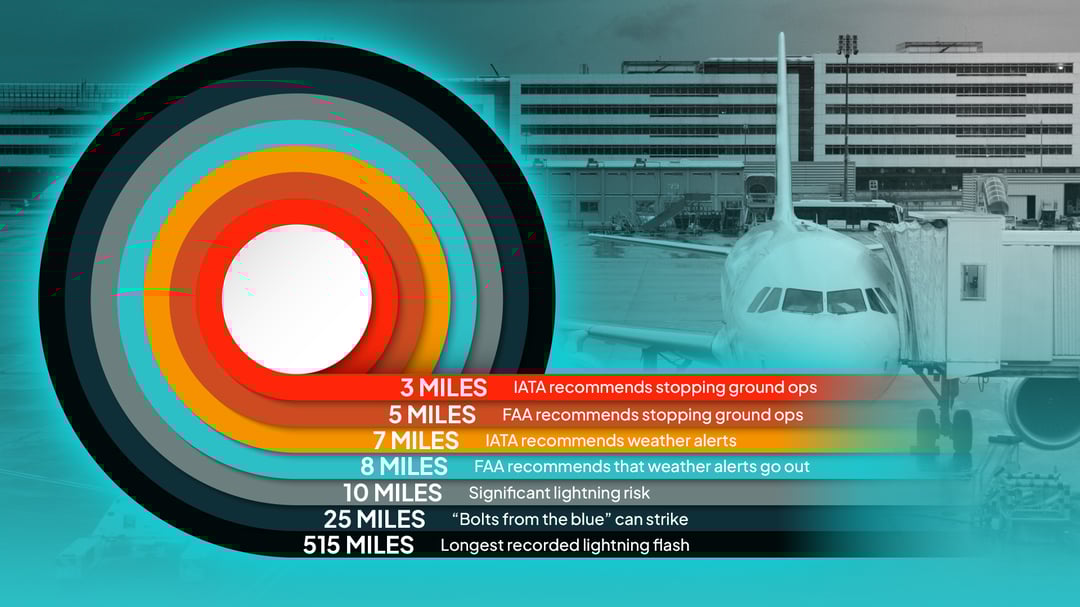
You don’t have to be directly under a thunderstorm cloud to be struck by lightning. In fact, most lightning casualties don’t even occur under the storm cloud; they happen before or after the storm cloud moves overhead because people seek shelter too late or leave shelter too early. There is a significant threat within 6-10 miles of the storm.
Even beyond a radius of 10 miles, lightning risk does not shrink to zero. “Bolts from the blue” can travel more than 25 miles from a storm cloud and strike even when the skies above appear blue. The most extensive mega-flash ever recorded extended 515 miles from Dallas, Texas, to Kansas City, and it included cloud-to-ground strikes as far as 400 miles away.
While worker safety must always be a top priority, it simply would not be practical to shut down operations for even the most remote lightning risks. Every suspension of outdoor operations contributes to flight delays, which add up to billions of dollars for the industry each year. As a consequence, airports, airlines, and FBOs get saddled with the burden of balancing ground worker safety against operational efficiency.
WHAT DO AUTHORITIES SAY ABOUT LIGHTNING SAFETY?
A natural place to look for guidance would be outside authorities like the FAA and the International Air Transport Association (IATA), the global trade association for the world’s airlines. The challenge is that guidance has not been consistent across different authorities.
Although federal regulations do not provide an exact standard for suspending ground operations, the FAA Weather Research Division has recommended a critical safety radius of 5miles to close ramps and get workers indoors. They also recommend an 8-mile radius for issuing weather alerts to the operations team. And, they recommend resuming operations at least 10 minutes after the last lightning was spotted in the critical 5-mile radius.
The IATA, on the other hand, recommends that alerts go out when a thunderstorm is within 7-10 miles and that all outdoor ground operations be halted when it is within 3 miles.
In the absence of a single recommended standard, many airports, airlines, and FBOs have opted to err on the side of caution by following more stringent standards over less stringent ones.
Typically, if a lightning strike occurs within 5 mi (8 km) of the terminal, safety measures go into effect, and operations are halted until no strikes are detected for 15 minutes to safeguard ground crews, especially those refueling aircraft.
-Flight Safety Foundation
Establishing a lightning safety plan: Alerting stakeholders
One of the most important parts of any safety plan is communicating the risk to key stakeholders. Several factors can make or break an alerting system.
AUTOMATION
When it comes to alerting, automation is critical.
When alerts are not automated, the responsibility to receive and relay alerts typically falls on operations or ground handling managers. The problem is that these roles already carry numerous responsibilities. A missed call or text message could easily delay important information from getting to those who need it.
Unfortunately, there is no time for such delays. That’s because prevailing guidance has many airports alerting ground operations to halt when lightning is about five miles away. That’s already well within the range that lightning poses a significant risk. So, even the smallest delays in communication could be fatal.
MULTIMODAL COMMUNICATION
Speaking of missed calls and text messages, it’s also important to consider modes of communication. Phone calls, text messages, and emails might work fine for office workers. For those on the tarmac, calls may be difficult to hear, and workers may not have their phones out to see a text message.
The best alerting systems use multiple, complementary modes of communication. Strobe lights and sirens are ideal for quickly getting danger and all-clear signals to outdoor workers. A well-placed strobe light should be positioned for high visibility to ramp workers, and a well-designed siren should be loud enough to cut through much of the noise on the tarmac. Text messages and emails can work with strobes and sirens to provide additional information about the danger and appropriate next steps.
Establishing a lightning safety plan: Dealing with the two dimensions of lightning risk
Of course, lightning is only one of many weather hazards that airports, airlines, and FBOs must guard against. This is why it’s useful to consider both the primary risk that lightning poses on its own and the secondary risk that stems from its link to other severe weather hazards.
THE DANGER OF LIGHTNING STRIKES
On the one hand, lightning is dangerous in its own right. This is due, in part, to its extreme heat. The air around a lightning flash is about 50,000 degrees, which is roughly five times hotter than the sun.
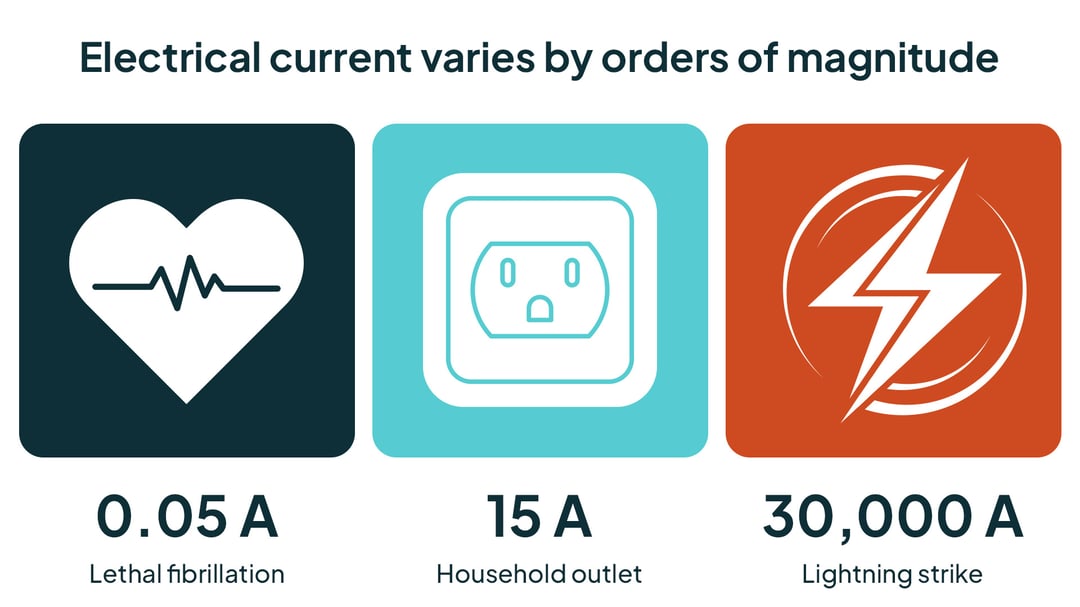
But the greater danger stems from the immense amount of electrical current that lightning carries. An average flash carries about 30,000 amps of electricity. To put that in perspective, it takes less than a single amp to cause potentially fatal heart fibrillation, and a typical household outlet delivers only 15 amps of electrical current. When lightning hits the ground, its current can be fatal up to 100 feet away.
LIGHTNING AS A SEVERE WEATHER SIGNAL
On the other hand, lightning can be an indicator of other dangerous weather conditions. That’s because the conditions that produce lightning (including high atmospheric instability, strong updrafts, windshear, and significant moisture) are the very same conditions that produce dangerous weather conditions like hail, tornadoes, and strong straight-line winds.
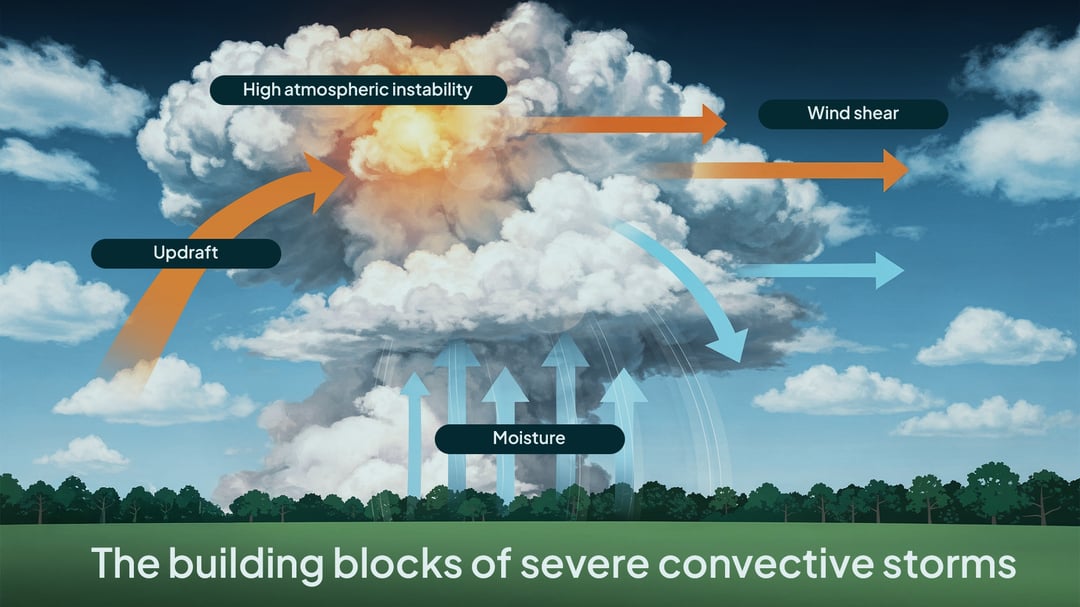
By analyzing the total lightning activity in thunderstorm cells, it’s possible to identify which storms are likely to produce significant non-lightning weather hazards. In fact, this kind of Dangerous Thunderstorm Alert can provide up to 45 minutes of advance notice before severe weather strikes.
Certainly, airlines, airports, and FBOs need to protect outdoor personnel against the immediate dangers of lightning strikes. But high winds, hail, and tornadoes can be equally dangerous to ground workers, and lightning data can play a key role in anticipating these hazards.
Centralizing oversight of lightning safety
Let’s be clear: automated alerting based on well-defined procedures and criteria can go a long way toward helping operational leaders meet their duty to protect ramp workers. But meeting that duty is not the same as relinquishing it.
Operational leaders should maintain situational awareness by monitoring potentially severe weather as it develops and approaches. Centralized visibility allows teams to confirm that alerts are being triggered as expected when predefined thresholds are reached.
At the same time, airports, airlines, and FBOs need governance over the alerting program itself. As FAA guidance evolves, as leadership revises operational thresholds, or as additional stakeholders emerge who require notifications, operators should be able to update alerting rules, escalation procedures, and delivery methods within a controlled, consistent framework.

From ambiguity to operational confidence: A defensible lightning safety protocol for airport ground operations
Lightning safety on the airport ramp is often framed as a question of distance—how many miles away is too close? But as we’ve seen, the real challenge is broader. Although OSHA establishes a clear duty to protect outdoor personnel from recognized lightning hazards, it still leaves critical implementation details unresolved. FAA research guidance, IATA recommendations, and industry benchmarks provide valuable reference points, but they do not always align into a single prescriptive standard.
This is the practical reality: It’s up to airports, airlines, and FBOs to translate a duty of care into protocols that are proactive, consistent, and defensibly grounded in reliable monitoring, clear shutdown and all-clear criteria, coordinated situational awareness, and rapid communication to those working on the ramp.
A defensible lightning safety plan should equip operators to:
- Monitor total lightning activity (not cloud-to-ground strikes alone) to reduce first-strike exposure and track storm escalation.
- Rely on verified observational detection (rather than prediction) for more reliable identification and fewer false alarms.
- Leverage resilient network-based (or hybrid) detection systems, which are better equipped to triangulate flash locations while delivering reliable coverage during severe conditions.
- Define clear shutdown and all-clear criteria, using FAA guidance, IATA recommendations, and widely cited industry benchmarks as reference points.
- Automate and deliver alerts through redundant channels, including sirens, strobes, and mobile notifications, to reach ramp personnel without delay.
- Maintain centralized situational awareness, so operations leaders share a real-time view of lightning activity and broader convective threats across the airfield.
- Document procedures and train teams, ensuring decisions are consistent, defensible, and understood across airport stakeholders.
When these elements are in place, lightning safety becomes more than a regulatory obligation. It becomes an operational capability that helps protect crews, reduce unnecessary disruption, and support confident decision-making.
Next step: Strengthen your lightning monitoring foundation
A defensible protocol ultimately depends on the quality of the monitoring and alerting system behind it. To explore what an effective lightning detection approach should include, read our guide: Weather Management Solutions for Airport Operations.